Situation
The Problem
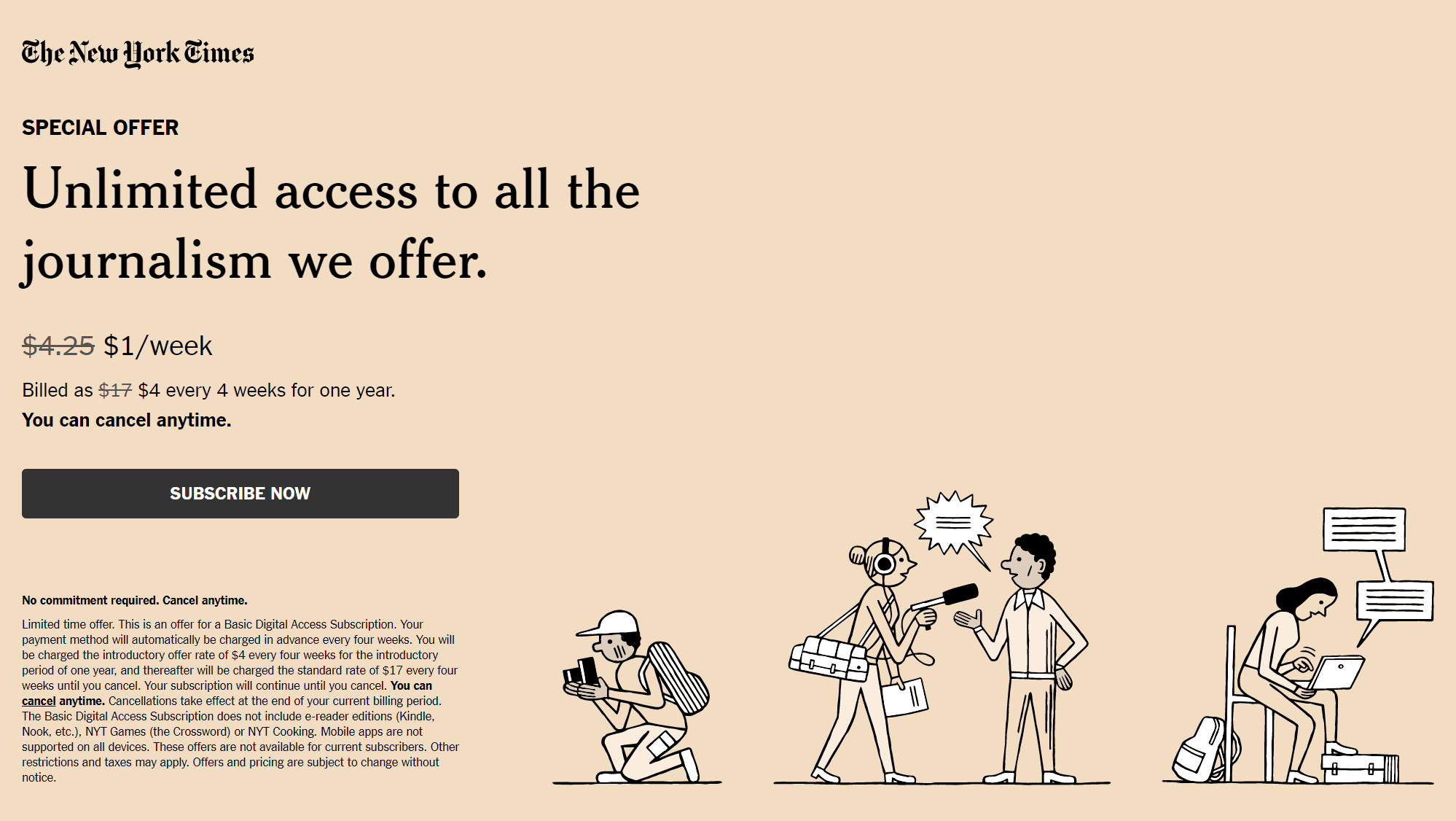
In early 2011, The New York Times (The Times) implemented a paywall to address issues related to declining profitability and subscription growth due to the internet’s rapidly growing popularity. They selected a device-specific and metered system paywall format and managed to grow their digital subscription user population to 390K people. Despite this achievement, lingering questions remained such as:
- Will paid subscriber growth continue?
- Will subscribers enticed by the introductory offer actually pay full price?
- Will digital subscription cannibalize print subscription?
These questions raise a larger problem over whether The Times can maintain relevancy and good financial health in the future. This is because a paywall might be seen as a stopgap used to prevent further declines that doesn’t necessarily account for changes in consumer behavior when interacting with and consuming news content, especially when factoring in the latest advancements in technology.
Tasks
The following tasks were completed to address the challenges raised by this case study:
- Synthesize research findings to formulate a problem statement
- Generate ideas using various ideation methods to identify possible design solutions
- Create prototypes of top 3 ideas based on level of effort involved and overall value
- Test prototypes on users and gather feedback
My Actions
Research
In order to get a better understanding on the role of The Times’s paywall, I used a combination of primary and desk research methods to answer the following key questions:
- What is The Times?
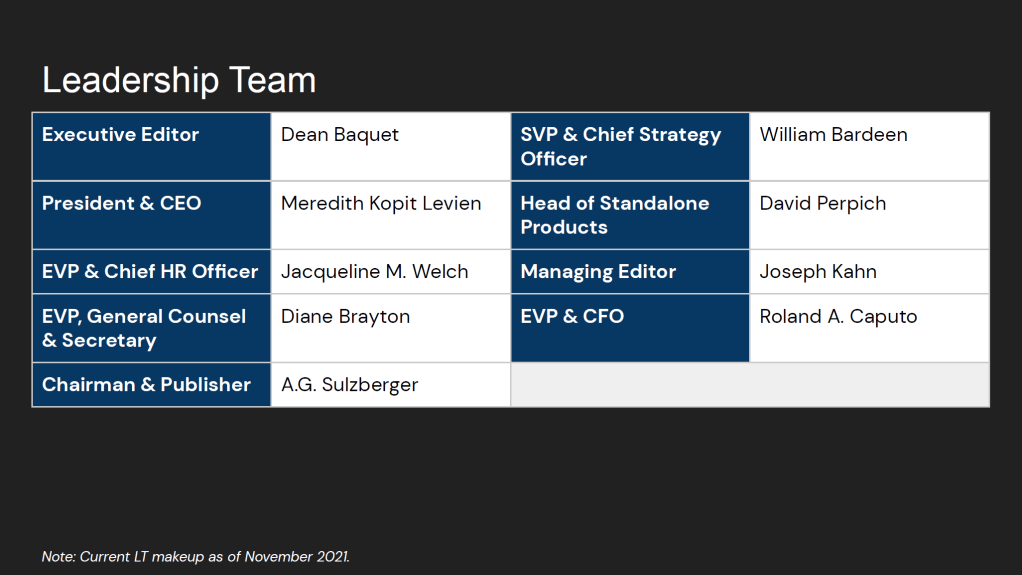
- Who are the key decision-makers?
- How is the financial health of The Times?
- What are the different paywall types currently in use within the news media industry?
- Which paywall type is being used by The Times?
- How are paywalls generally perceived by users?
Early Insights
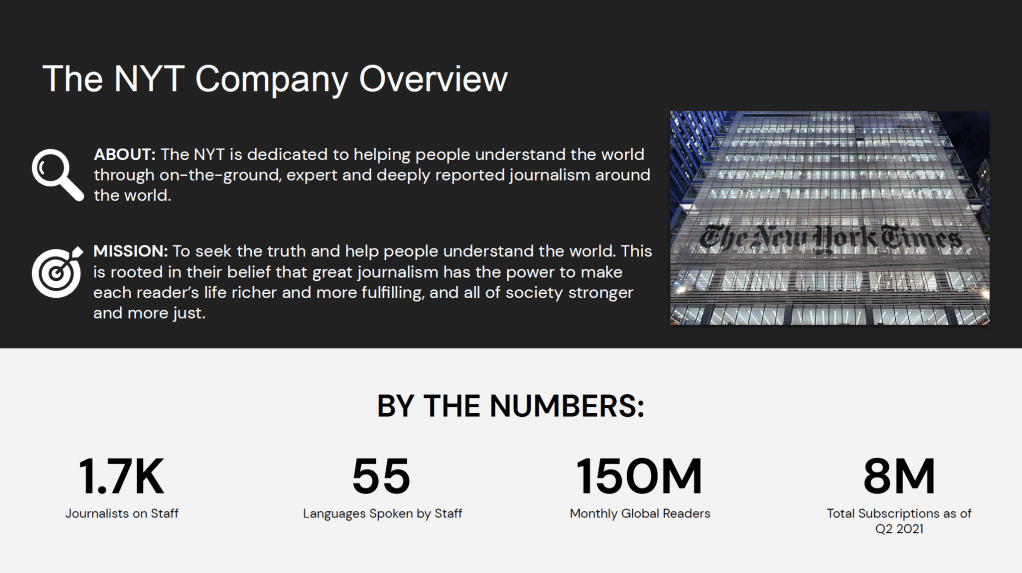
I gathered the following preliminary research data from an online search of existing materials and sources to better understand The Times, who the key decision-makers are, and the current financial health of The Times.

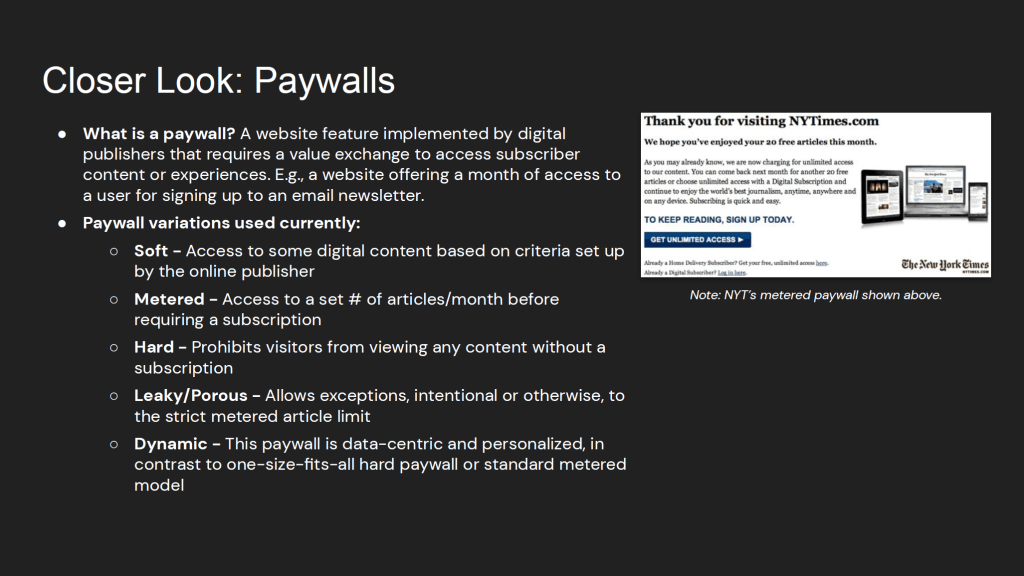
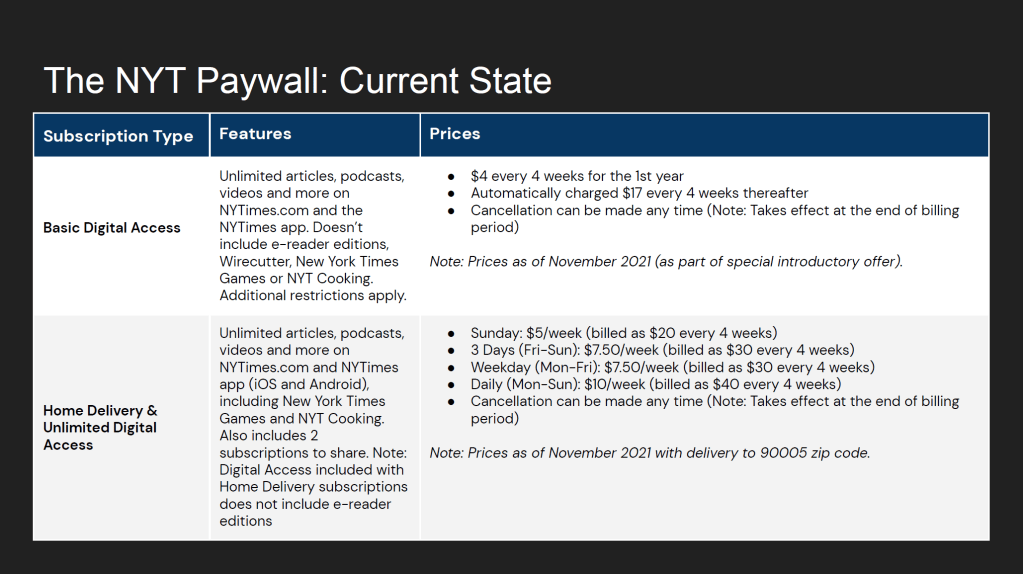
The findings below showcase paywall types commonly found across the U.S. news media industry, drawbacks, and the current state of The Times’s paywall.

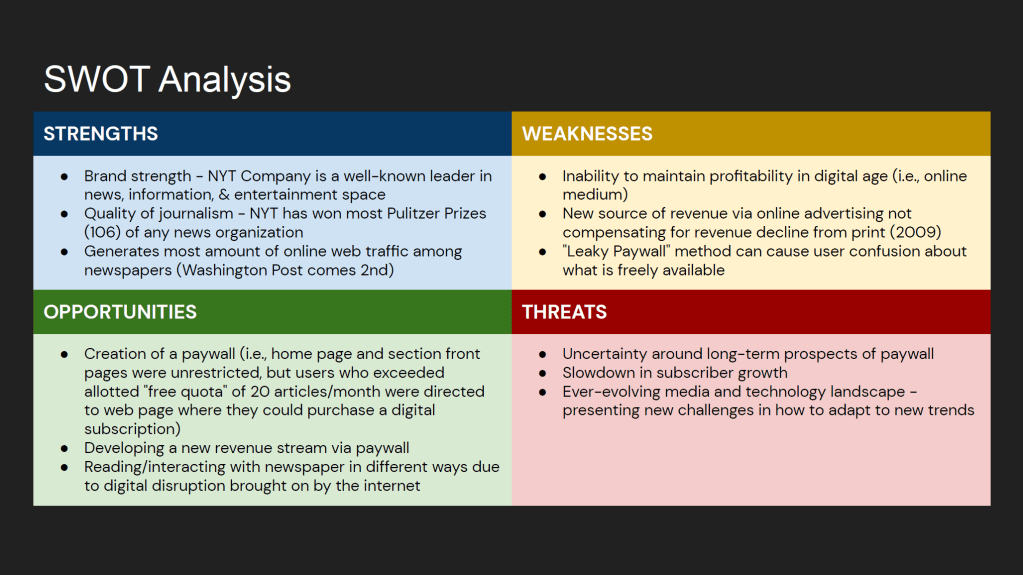
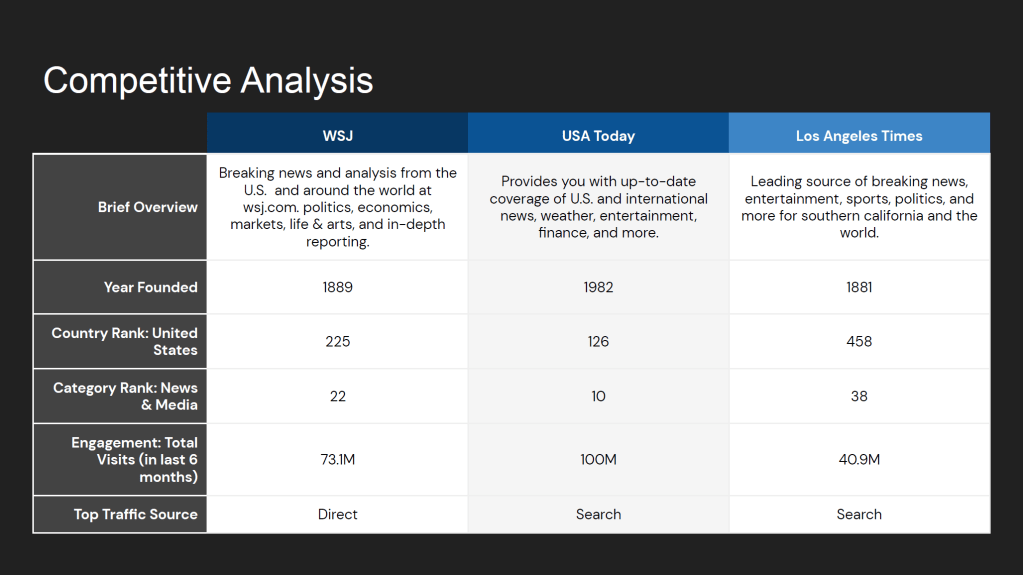
The findings below detail the strengths, weaknesses, opportunities, and threats of The Times and its paywall as well as the competitive landscape of the U.S. news media industry.
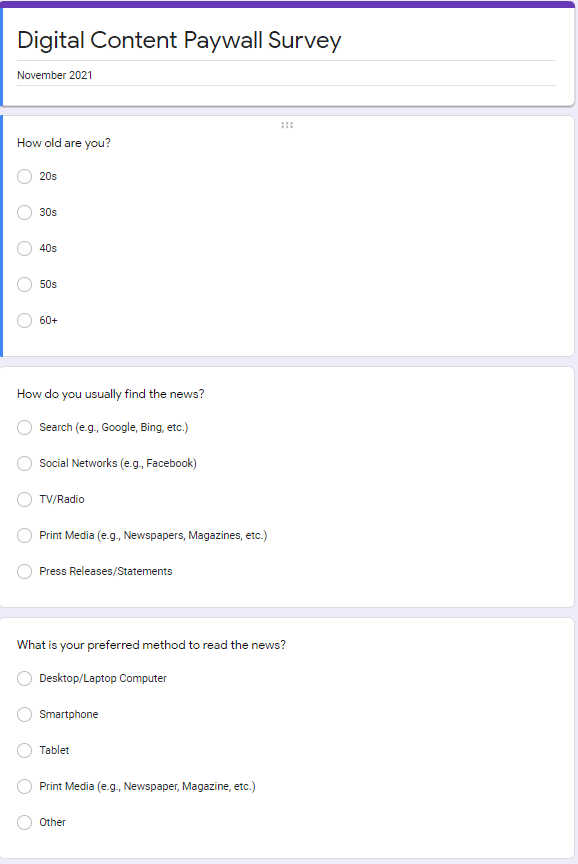
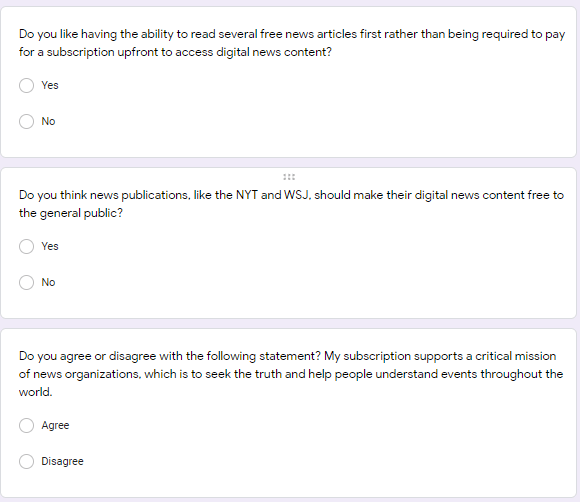
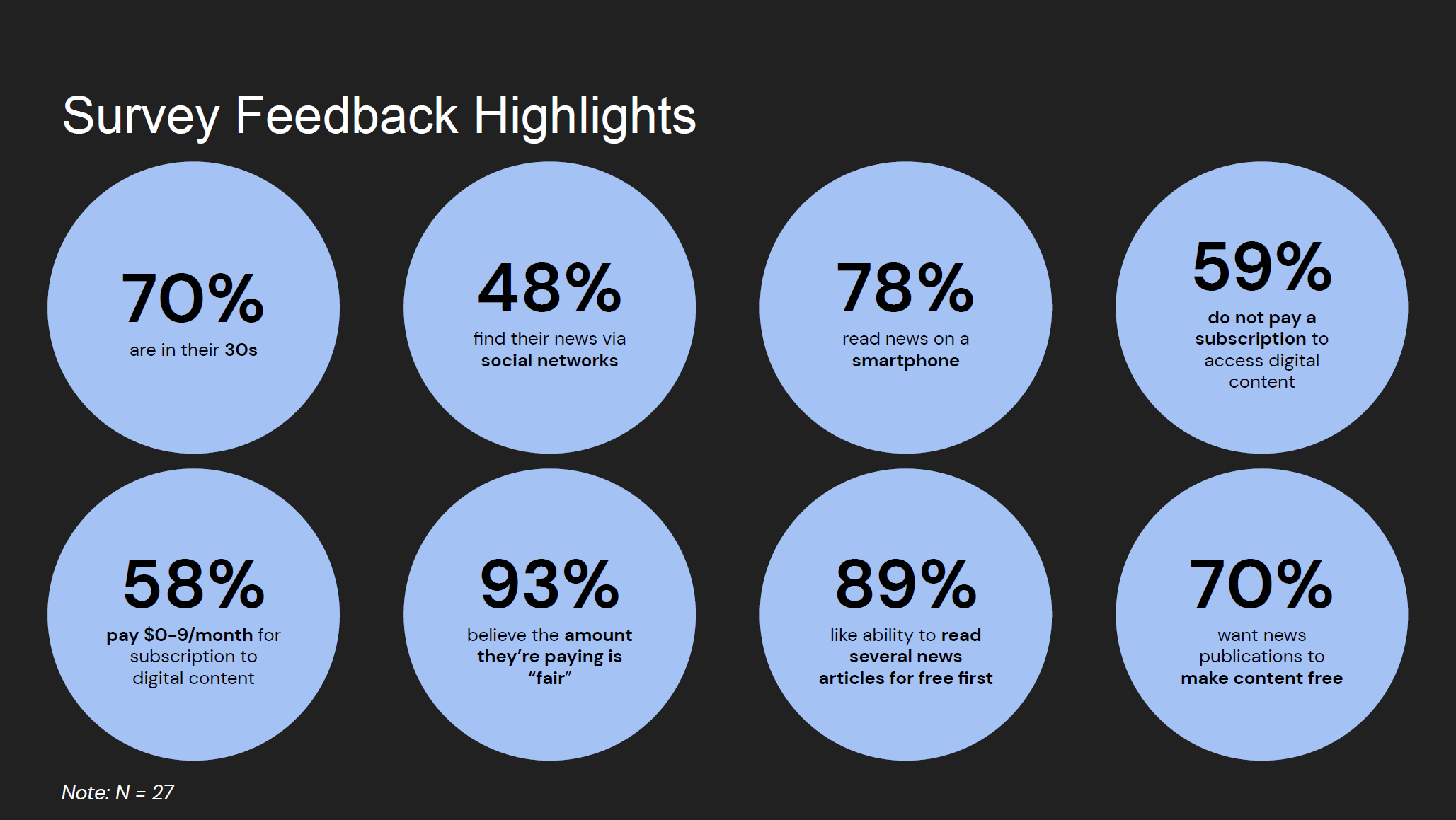
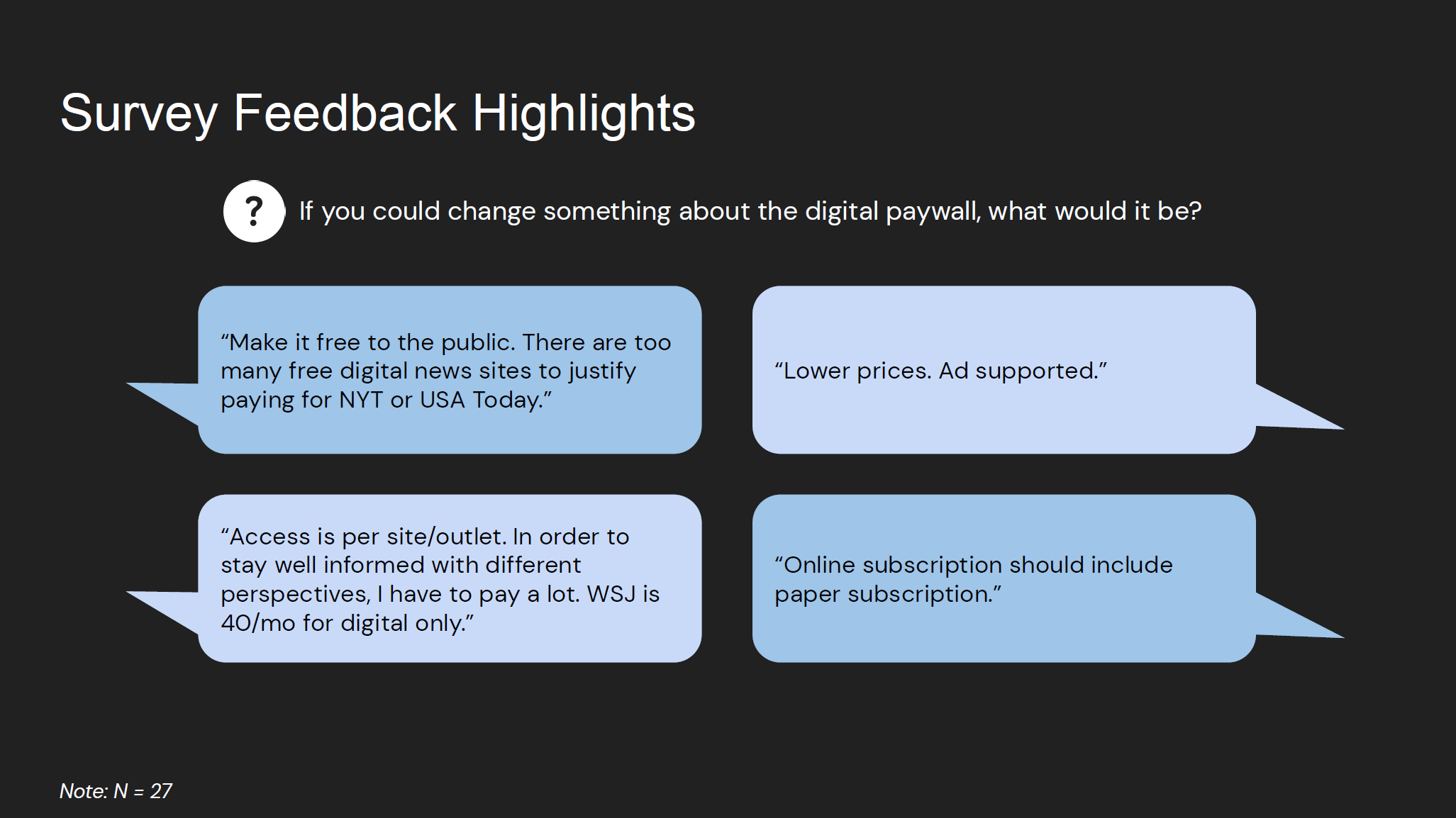
I conducted an online survey on 27 people to gather direct feedback on their views and attitudes toward paywalls. See below to view the survey distributed to participants as well as key feedback highlights.

Ideation
After gathering a sufficient amount of data from primary and desk research methods, I formulated the following “How might we…” questions to trigger possible ideas that could address the stated problem.
- How might we…
- Make changes to the The Times’s digital paywall to ensure subscriber growth continues climbing upward in the future and remains viable long-term?
- Reimagine how news will be consumed by people in the future in order to identify new sources of revenue, especially when taking into account advancements in technology?
- Ensure that users enticed by the introductory offer pay the full weekly amount to access The Times’s content?
- Deliver news content in other formats (e.g., TV, radio, virtual reality, mobile app, etc.) to attract new audiences and generate more revenue?
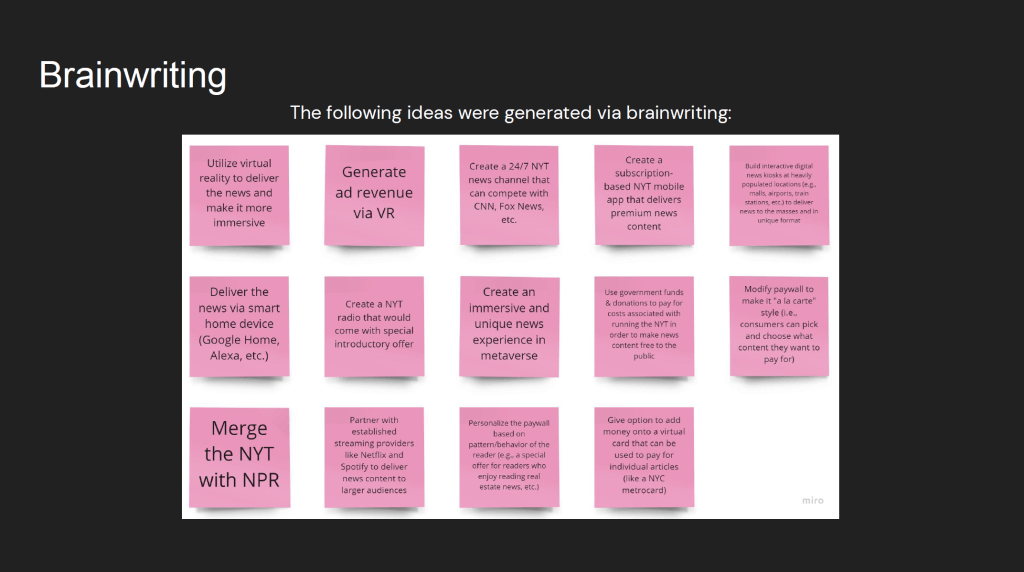
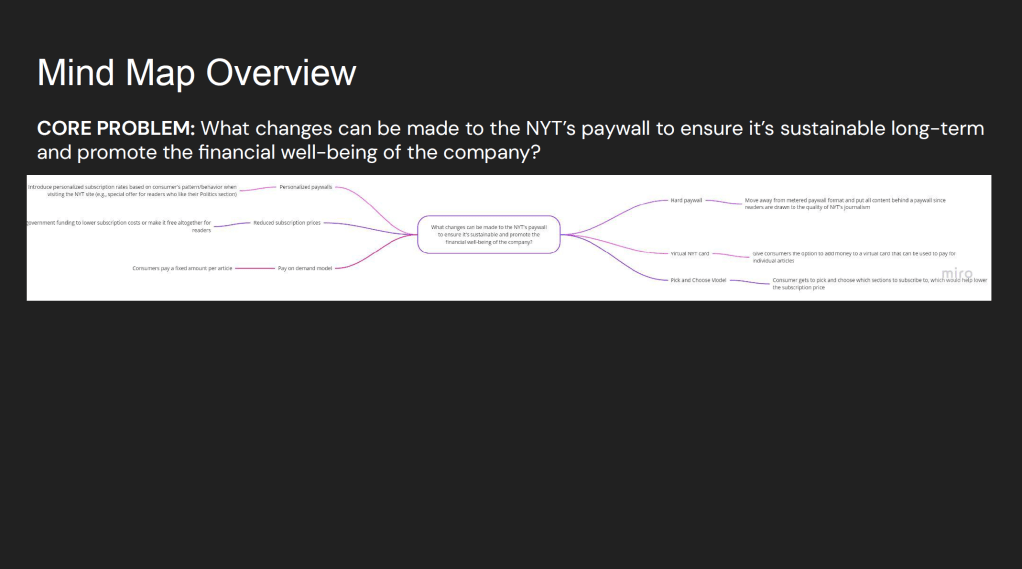
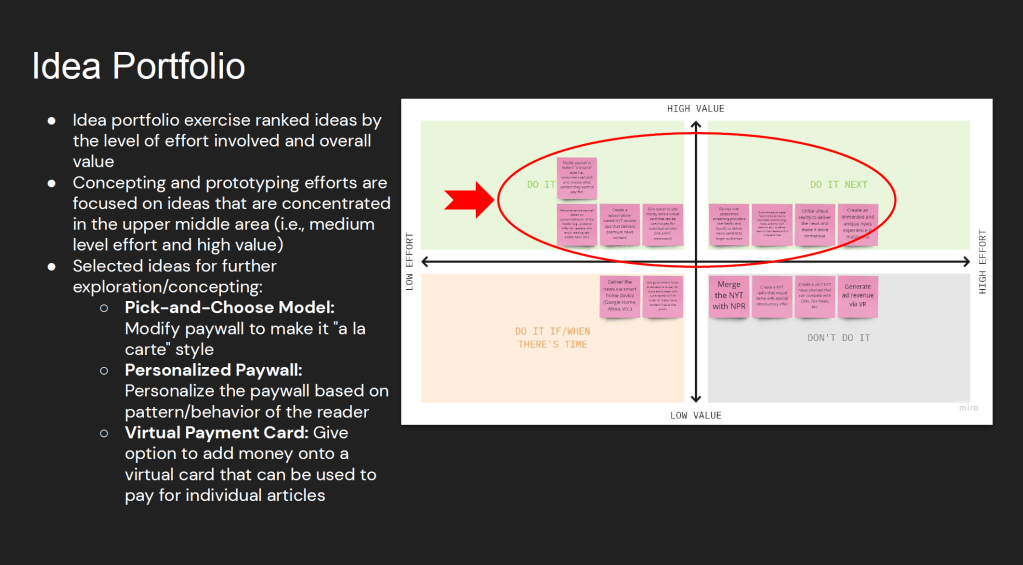
I completed additional ideation activities to generate as many ideas as possible, including brainwriting and mind mapping, and sorted these ideas in an idea portfolio chart to rank those with the highest value and least amount of effort involved.
Concept
After completing several rounds of ideation, I pursued a concept that explores a modified version of The Times‘s paywall that aims to provide users greater flexibility, more ways to pay for news content, and a personalized experience based on their reading pattern and behavior on The Times’s website and/or mobile app. Features include:
- Pick & Choose Model: Gives users “a la carte” style option to pick and choose which news sections they want to subscribe to.
- Personalized Paywall: Displays a personalized paywall based on the user’s reading pattern/behavior on The Time’s website and/or mobile app.
- Virtual Payment Card: Provides the option to add money onto a virtual card that can be used to pay for access to news articles, video content, etc.
Results
Prototypes
The following three prototypes are a visual representation of my concept.
Pick & Choose Model
- User clicks the rounded buttons to select news sections they want to subscribe to
- Price is displayed in the “Your Price” field
- User clicks the “SUBSCRIBE NOW” button to proceed to checkout

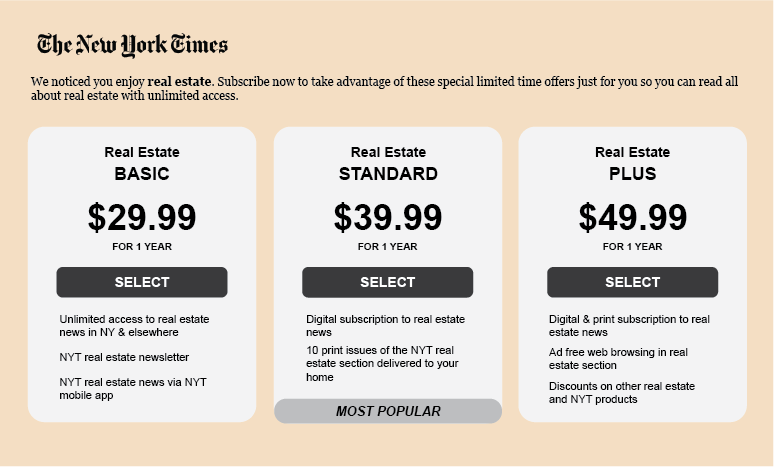
Personalized Paywall
- Paywall is triggered after the user has maxed out all free articles
- Offers special limited time subscription packages based on the user’s reading pattern/behavior on the The Times’s website and/or mobile app (e.g., user being offered special limited offers on The Time’s real estate section)
Virtual Payment Card
- User adds money to their virtual payment card to pay for access to news articles, video content, etc.
- User is not required to pay a monthly subscription if they pursue this option

User Interview Feedback Highlights
I conducted five user interviews in total and gathered feedback on the usability of my prototypes as well as pros and cons of each. See below for key feedback highlights.
“I think, for me, the second prototype is my favorite because a lot of people are into social media platforms like TikTok. You’re seeing a lot of experiences that are similar to what TikTok provides – an experience where you’re shown content that you prefer and are based on your personal likes and interests. The only change I would make is to add an introductory offer before being asked to pay the full price.”
Drew, Early 30s, Sr. Manager, Talent Management
“My preferred prototype is the virtual payment card. Let’s say that every article you read is behind a paywall, even on search engines like Google, I would then be more likely to add money to a digital card. However, the funny thing is, I’d prefer to use the card for news aggregators like Google because that’s where I personally read the news. One change I’d make is to allow access to news content across different platforms and news publications, similar to what you find on ClassPass.”
Evan, Late 20s, Web Developer
“I go back and forth between the Pick & Choose and Digital Payment Card prototypes. The reason I like the 1st one is the “a la carte” feature where you have a range of options and can maximize or take away things. The subscription is super custom tailored to you based on what your interests are and budget. The reason I like the 3rd one is the “pay per view” aspect. This would be best suited for readers who don’t want to be tied to a subscription and only want to pay for the article they’re reading in the moment.”
Jake, Late 20s, Data Scientist
“The “a la carte” style prototype makes the most sense to me considering that I’m not an ideal customer that The New York Times would be going after. It would be a great way to get me interested more about The New York Times and get me to subscribe. Honestly, I oftentimes don’t look too carefully for articles from them. I’ll instead look at headlines and search for them on search engines to find free content. My least favorite was the personalized paywall because that’s an annual commitment.”
Jane, Early 40s, Sr. Content Marketing Manager
“The Virtual Payment Card prototype is the most attractive to me if I don’t want to commit to a monthly or annual subscription, so I would try this one out. I also think it depends on how much money I’m required to load upfront. If it’s too high, then that might be a barrier. My least favorite was the Pick & Choose prototype because I think most people aren’t sure what news content they want to consume.”
Nick, Early 30s, Psychiatrist
Updated Prototype
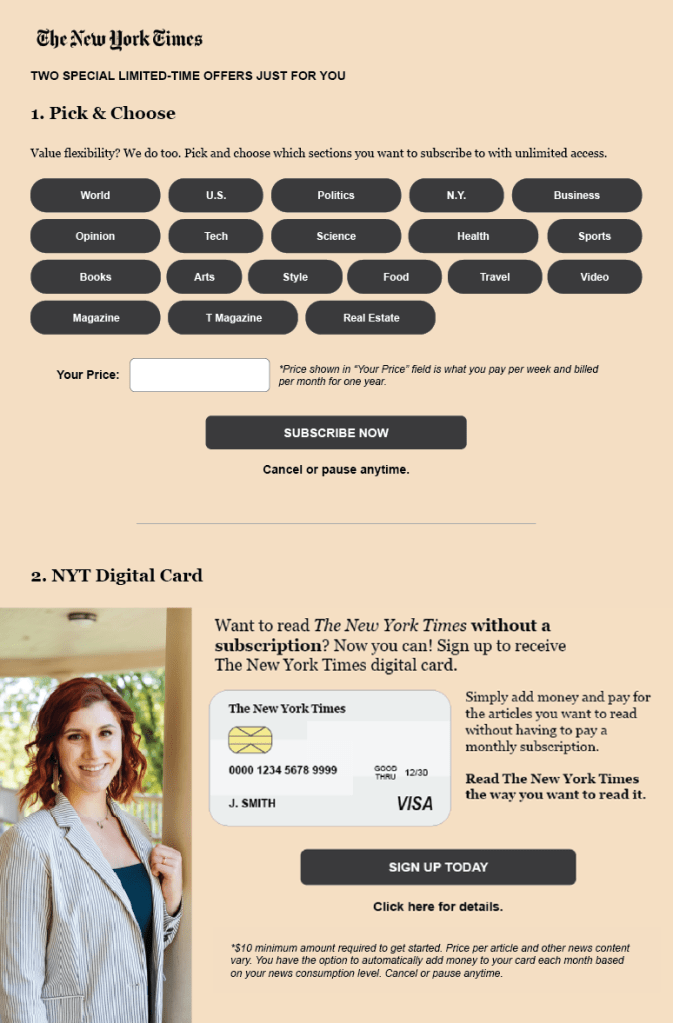
Since most interviewees indicated a preference for the Pick & Choose and Virtual Payment Card prototypes, especially the “a la carte” and “pay per view” features, I updated my prototype by combining them together so users can conveniently review both offers all on one page. This gives users the ability to either pick and choose which news sections they want to subscribe to on a monthly/annual basis OR create a digital payment card to pay for access to individual news articles, videos, podcasts, etc. in one place. See below for key changes.
Key Changes:
- Combined both Pick & Choose and Virtual Payment Card prototypes into one paywall
- Added additional details clarifying each offer next to “Your Price” field and below “Click here for details” link
- Tabled Personalized Paywall prototype
Next Steps
The following next steps will need to be completed to address the stated problem and close out this case study:
- Test updated prototype
- Collect additional feedback on updated prototype via future user research studies (e.g., user interviews, usability testing, etc.)
- Provide final recommendation to address the problem statement
About The New York Times:
The New York Times (The Times) is an American daily newspaper with global readership. The Times is owned by The New York Times Company, which is publicly traded and headquartered in New York City. Visit their website here.
My Role – UX Research & Design:
- Define the UX goals, objectives, and strategy
- Gather key insights via user research methods
- Develop several prototypes to address challenges raised by this case study
Project Duration:
1 month
Results:
- 3 prototypes (i.e., Pick & Choose, Personalized Paywall, and Virtual Payment Card)
- Key insights derived from user interview feedback
 Jay Song